
Signs of imposter syndrome at work can be hard to recognise, especially when you are doing well on the outside. Other people may see you as capable and successful, yet underneath it, you still worry that you are not as competent as they think. Part of you fears that, at some point, you will be found out.
If that feels familiar, you are far from alone. Research suggests that many people experience imposter feelings at some point in their working lives. First described by psychologists Pauline Clance and Suzanne Imes in 1978, imposter syndrome is a persistent sense of fraudulence that can continue even when there is clear evidence of competence.
That is part of what makes imposter syndrome at work so exhausting. Reassurance may help briefly, but it rarely changes the deeper belief underneath.
Often, the first step is recognising the signs of imposter syndrome in daily working life. Once you can see the pattern clearly, it becomes easier to understand how imposter syndrome affects your career, confidence, and visibility over time. Here are seven common signs.
The infographic below summarises the most common signs of imposter syndrome at work.
Signs of imposter syndrome at work
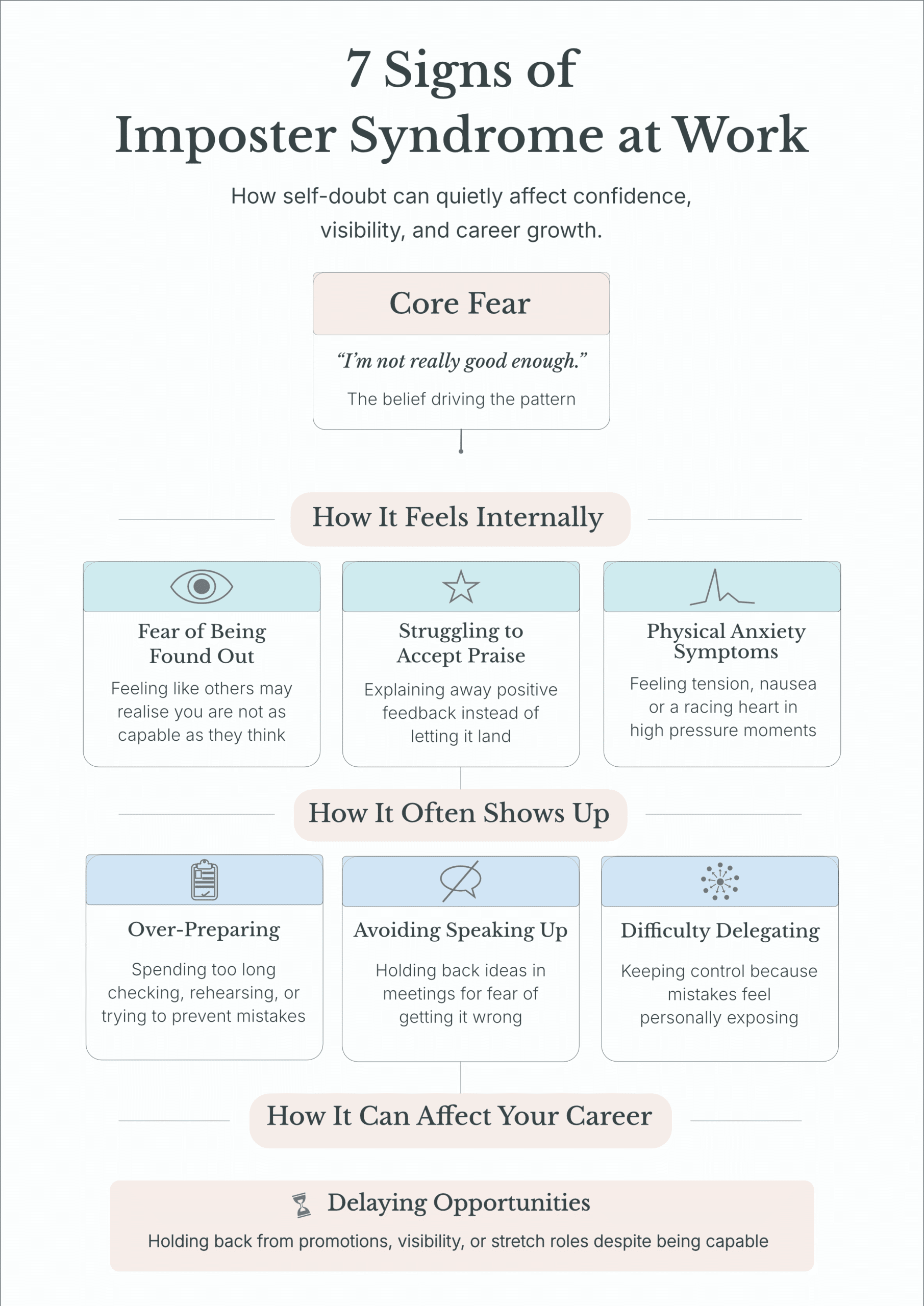
A visual summary of the most common signs of imposter syndrome at work, including internal experiences, behaviours, and career impact.
These are some of the most common imposter syndrome symptoms at work, but they often run deeper than they first appear.
1. You feel like you're about to be found out
This is the core experience of imposter syndrome at work. It is not just self-doubt. It is the fear that other people will eventually realise you are not as capable as they think.
Even when there is evidence that you are doing well, the internal narrative remains unchanged. Instead, it keeps saying, "I am not really good enough." It is only a matter of time before people see it.
This is one reason imposter syndrome feels so draining. You're doing your job, but you're also managing a constant fear of exposure in the background.
2. You over-prepare for everything
Preparation is not the problem. The difference is in the motivation behind it.
Over-preparing isn’t about doing your job well. It’s about trying to eliminate the possibility of exposure.
When you are preparing to do your job well, there is usually a natural stopping point. When you are preparing because you fear being found out, there often is not. You rehearse answers to questions that may never be asked. You recheck work that is already good enough. You spend four hours on something that needed two.
Over-preparing can create a short-term sense of control, but it often comes at the cost of time, energy, and peace of mind. What looks like conscientiousness from the outside may actually be one of the more hidden signs of imposter syndrome symptoms at work.
3. You avoid speaking up in meetings
You know you have something to add. Still, before you speak, your mind races: What if you missed something? What if someone questions you and you can't answer? What if everyone already knows what you are about to say?
You rehearse what you might say, decide it is not quite right, and by the time you are ready, the moment has passed.
So in the moment, you stay quiet — even though you know you have something valuable to add.
Over time, this adds up. You keep your ideas to yourself, your influence shrinks, and as others speak up easily, it seems like their confidence is genuine. This can make you feel even more different.
For professionals in mid- or senior-level roles, this is one of the most overlooked symptoms of imposter syndrome at work, and the patterns can be hard to spot. On the outside, you may look calm and confident, but self-doubt is happening inside.
4. Praise feels uncomfortable
For many people with imposter syndrome, praise does not land as evidence. Instead, it feels like added pressure.
Instead of accepting positive feedback, you might brush it off. You tell yourself it was just luck, good timing, low standards, or someone being kind. You downplay your part and assume anyone else could have done the same.
This goes beyond modesty. It becomes a habit of dismissing evidence that challenges your self-doubt.
That is why success often doesn't boost your confidence, while mistakes feel much bigger than they are. Noticing these imposter syndrome signs at work can help you address what is standing in your way.
5. You delay or avoid opportunities
So even skilled people stay where they are, doing work that doesn't challenge them and letting chances pass. It is not about a lack of ability, but about strong self-doubt.
This is one of the clearest signs of how imposter syndrome affects your career. It does not always stop people from achieving, but it can slow progression, reduce visibility, and lead people to hold back from opportunities they are ready for.
6. You struggle to delegate
This often emerges later in your career, once delegation is possible. It may look like perfectionism, but it differs in its essence.
If you're a perfectionist, you worry the work won't be good enough. With imposter syndrome, the worry is more specific. If you hand something over and it goes wrong, it feels like proof that you were never managing as well as people thought.
It feels safer to do everything yourself. You keep track of every detail, hoping that being indispensable will give you some sense of security.
But this comes at a cost: you have less capacity, your team grows more slowly, and the line between work and life blurs.
7. Anxiety shows up physically
Imposter syndrome isn't just mental. It can also show up physically, especially in high-pressure situations.
Before a presentation, important meeting, or performance review, you might notice nausea, a tight stomach, tense muscles, or a racing heart. When your mind senses a threat, your body reacts—even if the threat is only in your thoughts.
These physical reactions are often part of imposter syndrome at work, especially when you are being evaluated or are in the spotlight.
If you recognise these signs of imposter syndrome, you may also want to read my article on how stress and anxiety can affect digestion.
Imposter syndrome at work isn't an accurate reflection of your real ability. It's a pattern that you can learn to recognise and change.
Recognising the signs is one thing. Understanding where they actually come from is another — that's the part most advice skips.
How to break the pattern of imposter syndrome at work.
If several of these signs feel familiar, it does not mean you are not capable. It means a pattern may be running beneath the surface.
Imposter syndrome often has deeper roots than the workplace itself. It can develop through early experiences, messages about achievement or worth, or environments where being “good enough” never felt secure. By the time these patterns show up in your career, they can feel like facts. But they are not facts. They are learned responses.
This is also why surface-level strategies often do not create lasting change. Reassurance, positive thinking, or being told to "just be more confident" may help briefly, but they do not always reach the deeper beliefs driving the pattern.
When those deeper beliefs start to shift, your confidence becomes steadier. You don't need constant reassurance, and setbacks stop feeling like proof you were never good enough.
This is the work I do with clients: not just managing symptoms, but changing the beliefs that drive them.
If you want support with imposter syndrome at work, confidence, or performance anxiety at work, you can check out my services here.
Frequently asked questions.
What are the signs of imposter syndrome at work?
Common signs of imposter syndrome at work include feeling as though you are about to be found out, over-preparing, avoiding speaking up in meetings, struggling to accept praise, delaying opportunities, finding delegation difficult, and experiencing physical anxiety before high-pressure situations.
Can imposter syndrome affect your career?
Yes. Imposter syndrome can affect your career by reducing confidence, making you less likely to speak up, delaying applications or promotions, and causing you to hold back from opportunities you are capable of handling.
Is imposter syndrome linked to anxiety?
Imposter syndrome and anxiety are often closely linked. Many people notice anxious thoughts, physical tension, nausea, or a racing heart in situations where they feel judged, visible, or under pressure.
References