
Your coworkers think of you as someone who works hard, pays attention to details, and gets things done. They know you're always prepared, evade unexpected issues, and complete your work.
In your own mind, it never feels like enough. You play conversations over in your mind that may never happen. You rewrite emails that were already fine, and spend twice as long on tasks as necessary. Even after all that, you still feel you could have done more. This isn't always about being thorough. Sometimes, fear is what drives it.
Over-preparing at work is a hidden habit that frequently goes hand in hand with imposter syndrome. It can look like a strength on the surface, but there's usually something deeper going on.
What over-preparing at work can look like
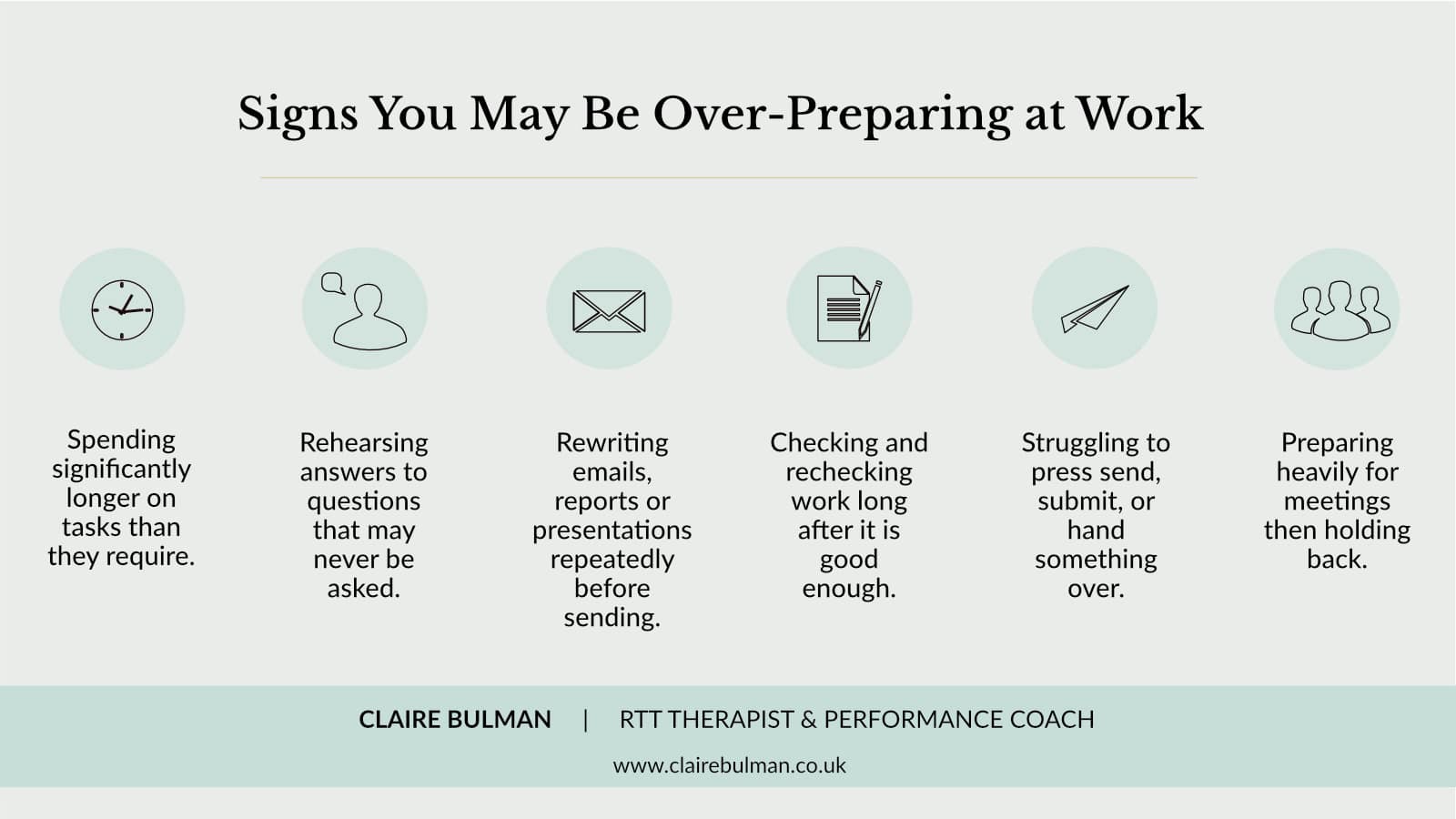
This pattern can show up in different ways depending on your job and workplace. Here are some common signs:
- Spending significantly longer on tasks than they require
- Rehearsing answers to questions that may never be asked
- Rewriting emails, reports, or presentations repeatedly before sending
- Checking and rechecking work long after it is good enough
- Struggling to press send, submit, or hand something over
- Preparing exhaustively for meetings, then holding back when in the meeting.
- Finding it difficult to begin something until you feel completely ready
That last point is important. Over-preparing isn't just about doing more work. Sometimes, it means waiting until you feel completely ready before sharing your work with others.
Why capable professionals over-prepare
The main difference between being thorough and over-preparing is what motivates you.
Most professionals can tell when their work is ready. However, if you are worried about making mistakes, you might keep editing your work again and again. Instead of finishing, you end up preparing as a way to cope with anxiety.
When you feel anxious, you might notice these common fears:
- Worrying about making a mistake in front of others
- Feeling nervous about being asked something you can't answer
- Worrying that others might see you as less capable than they thought
- Feeling afraid that your flaws or mistakes will be revealed
The word ‘exposed' is important. It means something very specific.
The link between over-preparing and imposter syndrome at work
A big part of imposter syndrome is the fear that others will eventually realise you're not as capable as they think. It's not just self-doubt, but the worry of being found out.
Over-preparing is one way to manage fear. If I know everything, no one can catch me out. If I rehearse every possible question, I won't be caught off guard. If my work is flawless, there will be nothing to criticise.
This might help you feel safer for a while. But if you don't address the fear behind it, preparation never feels finished. It can also leave you feeling tired. There's always another question to practice, another detail to check, or another draft to edit.
If this feels familiar, you may also recognise other signs of imposter syndrome described in my article, "7 Signs of Imposter Syndrome at Work."
When diligence becomes self-protection
Preparation itself isn't the problem. Being thorough, planning, and taking your work seriously are real strengths.
A solicitor spends four hours going over a document they have already checked twice. They know it is ready. Still, sending it out feels risky, so they read it again, make small changes, and second-guess themselves. It is as if, once sent, the document will show what they can really do. So they read it again.
The problem starts when preparation is no longer about quality, but more about protecting yourself, not exposing yourself. The key difference is what you're trying to avoid. Being thorough helps you do good work. Over-preparing, when tied to imposter syndrome, is about trying not to be seen as not good enough.
That shift in motivation makes a big difference. Preparation never really ends. You can't completely eliminate the risk of exposure. There will always be a question you didn't practice, a situation you didn't expect, or a moment when you're seen before you feel ready.
When you over-prepare, you might feel more in control for a short time. But in the end, it doesn't solve the problem; it may make the fear even stronger.
How over-preparing affects confidence and performance
People often miss this part. Over-preparing doesn't just waste time. It can actually hurt the confidence and performance it is supposed to help. Some of the ways it does this:
- It slows down decision-making. When every task needs more preparation before it's done, work moves more slowly. In senior roles, where fast decisions matter, this can really stand out.
- It can also add more pressure. The more you prepare to feel safe, the higher your standards get. What started as one extra check can turn into three, and this keeps growing and gets out of hand.
- It makes communication feel less natural. When you rehearse too much, your responses can sound stiff. In meetings, presentations, and conversations, over-preparing can make you seem less relaxed than you really are.
An executive who spends a lot of time preparing for client presentations often ends up sounding more stiff in the room than colleagues who prepare less. Their rehearsed answers come out a bit too slowly. When someone asks a follow-up question, it catches them off guard. They may look blank for a moment or stumble over their reply, not because they do not know the answer, but because they did not rehearse that exact version.
It additionally reinforces the idea that you can't trust yourself. Every time you check your work again, you're telling yourself your first instinct wasn't good enough. Over time, that belief gets stronger.
It limits what you can achieve. The time and energy you spend over-preparing aren't available for other things. Creative thinking, new ideas, and being noticed at work can all get pushed aside. For more on how imposter syndrome affects confidence and career progression, you may want to read my article on why capable professionals stay quiet in meetings.
Who this pattern tends to affect
Over-preparing as a response to fear often shows up in people who feel more visible at work, especially when the stakes of being seen are higher. This often happens to professionals who have just been promoted, changed roles, or started a new job, and are unsure how others see them. It is also common in people who have received criticism or close scrutiny earlier in their careers, or who grew up in places where mistakes weren't handled well.
It's important to be clear: people who over-prepare like this are usually not less capable than others. In fact, they're often more capable. The real issue isn't ability, but the beliefs underneath.
How to start changing the pattern
These suggestions won't solve the deeper pattern on their own. But they can help you start noticing what's happening and begin to interrupt it.
Decide what 'done' means before you start. Instead of preparing until it feels right, define what a finished, good-enough version looks like ahead of time. If it helps, set a time limit. Without a clear endpoint, the habit of over-preparing can grow.
Notice when checking your work turns into reassurance-seeking. There is a difference between checking something once because it makes sense and checking it three times because you still feel anxious. If you find yourself going over work you already know is fine, then you need to stop and reflect on what you are doing.
Practice finishing a task when it's 'good enough'. Challenge yourself to check it once. So, read the email once, submit the report after one final check, and don't wait for perfection. The discomfort you feel is helpful; it shows you where your fear is.
Separate preparation from performance. When you over-prepare, it is easy to forget that the goal isn't a perfect result; it is a clear and useful one. Aim to communicate clearly, not perfectly.
Learn to be okay with not knowing every answer. In most workplaces, it is fine to say, "I don't have that information right now, but I'll get back to you." People who over-prepare often don't think this applies to them.
Why reassurance alone does not always solve it
Simple strategies can help reduce the urge to over-prepare, especially in the short term. But if your over-preparing comes from deeper beliefs about mistakes, your abilities, or what it means to be exposed, these strategies frequently don't last when things get tough. The beliefs come back. The urge to prepare more returns. The cycle keeps going.
This isn't a failure of effort. It's how patterns work when their roots go deeper than the behaviour itself.
Then the beliefs behind the pattern start to change, and your behaviour shifts more naturally. You don't have to keep fighting the urge to over-prepare, because the fear is not as strong anymore.
Over-preparing is usually a symptom, not the problem itself. This is how I work with clients: not simply managing the symptoms, but helping them understand and change the beliefs that drive these patterns.
Get support for over-preparing, imposter syndrome, and confidence at work.
If you find yourself over-preparing, second-guessing yourself, or worrying about being found out at work, it could be worth exploring what's behind it.
I work with qualified professionals in London and online, using RTT and coaching to address the beliefs behind imposter syndrome, performance anxiety, and self-doubt at work.
You can book a free consultation.
Frequently asked questions about over-preparing at work.
Is over-preparing at work a sign of anxiety?
Over-preparing can be linked to anxiety, especially when it is driven by fear of making mistakes, being judged, or being exposed. In that case, preparation becomes less about doing a good job and more about feeling safe.
Can over-preparing be linked to imposter syndrome?
Yes. Over-preparing is often one way professionals try to manage the fear of being found out, criticised, or seen as less capable than others think.
How do I stop over-preparing at work?
Start by noticing when your preparation turns into seeking reassurance. Try to decide ahead of time what 'done' means, avoid unnecessary checking, and examine the beliefs that might be causing your fear.
Does over-preparing affect confidence?
Yes. Over-preparing can make you feel like you can't trust yourself, set higher standards for feeling ready, and make it harder to communicate naturally.
References
Bravata, D. M., et al. (2020). Prevalence, predictors, and treatment of impostor syndrome: A systematic review. Journal of General Internal Medicine, 35(4), 1252–1275.