

A VP and department head at a major bank seemed to have it all—a respected title, a good salary, and a seat at the table. But whenever he was asked to speak at Board meetings, he felt intense physical anxiety.
He had trouble sleeping and often skipped meals. His anxiety put a strain on his relationship. He kept replaying situations in his mind and doubting himself, which left him feeling drained.
After every meeting, he went over every comment people made to him.
In reality, most of the feelings and thoughts he had about his colleagues weren’t true. They came from limiting beliefs he formed at age 7.
The voice that told him to stay small, warned that speaking up would only cause anger and pain, and insisted his contributions didn’t matter?
It wasn’t really his own voice.
Maybe you recognise this pattern. It may not happen in the boardroom, but in a meeting where you had a great idea and stayed quiet. On the way home, you replay what you wish you’d said. You keep second-guessing yourself, worried that speaking up will only make things worse.
That critical inner voice feels like it’s you, like it’s the truth, and like it’s just who you are.
But here’s what most people never realise: that voice isn’t really yours. Yet it has been holding you back for years.

How Limiting Beliefs Destroy Workplace Confidence
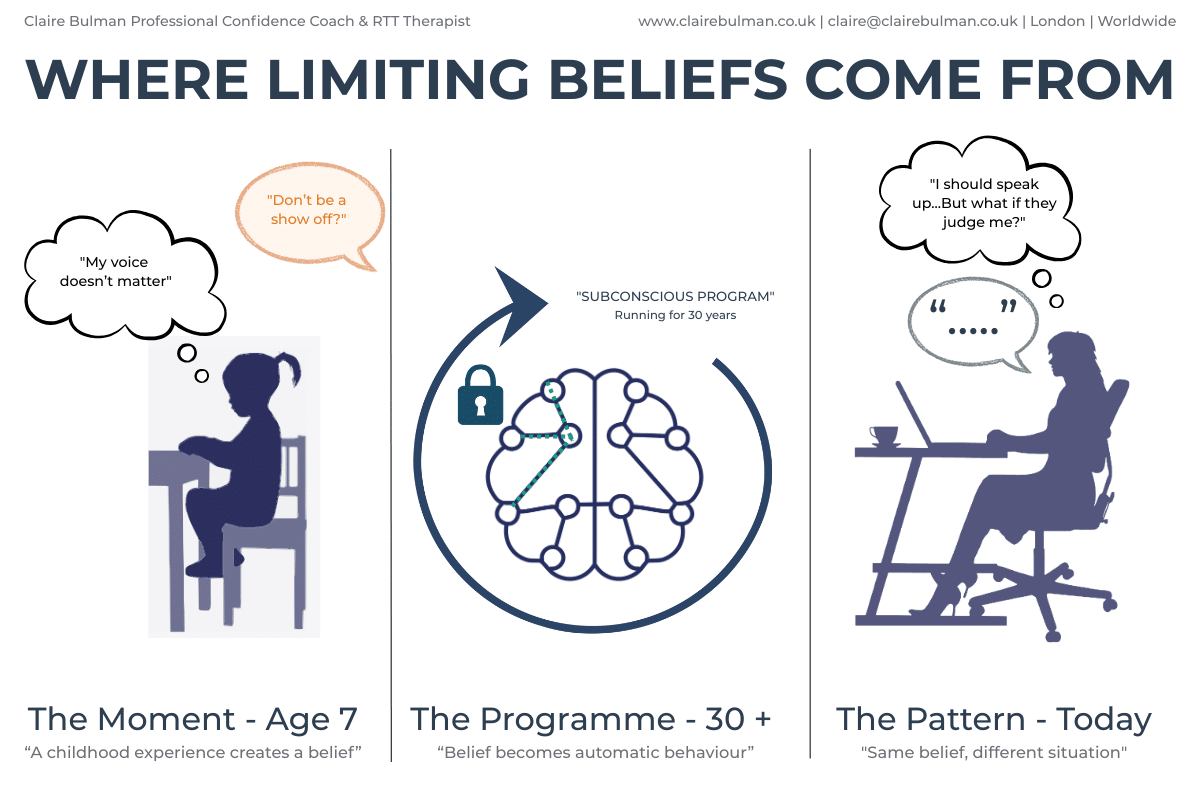
Let’s go back to the VP from earlier? His fear of aggression in board meetings started when he was seven. One night, after dinner, he spoke up, and this made his father angry. From then on, as a child, he decided that speaking up meant trouble, so he stayed quiet. Thirty years later, that limiting belief was still shaping his career. Here’s the hard truth: the voice in your head probably isn’t yours either.
Where That Voice Really Came From
That critical inner voice that tells you to stay quiet, not draw attention, and keep your ideas to yourself came from somewhere specific.
“Speaking up is pushy”
Maybe a parent once said, “Don’t show off, people won’t like you.” Now, thirty years later, you have great ideas in meetings but stay silent.
“I need to be certain before I contribute”
Maybe a teacher embarrassed you in the past for a wrong answer. Now, as a qualified professional, you overprepare for every presentation, afraid of being caught off guard.
“Good work speaks for itself”
Cultural messages about staying humble can make self-promotion feel wrong. So you stay quiet while others who may be less qualified speak up and get promoted. These aren’t just random worries. They are specific beliefs that started somewhere. These limiting beliefs directly impact workplace confidence, keeping qualified professionals invisible despite their capabilities.
How These Became Your Operating System
These beliefs formed before you could make your own decisions. When you were a child, you believed whatever adults told you. For example, if your father got angry at what you said, you didn’t think, “Dad’s having a bad day.” You thought, “Speaking up causes problems,” or maybe “What I have to say is not worthwhile.”
That VP’s father wasn’t a villain. He was probably stressed and overwhelmed, dealing with his own problems. But a seven-year-old can’t see the bigger picture. Kids remember moments like that as if they’re rules for life, and it happens automatically, without your awareness. You don’t consciously think about childhood experiences. Anxiety appears, your throat tightens, and the words dissolve. It happens so fast that you assume, “I’m just not confident enough.”
But that’s not your true self. It is someone else’s fear you’ve carried since you were a child.
The Evidence
Would you tell your best friend the things your inner voice tells you? “You’re not smart enough.” “Everyone will think you’re arrogant.” Of course not. Because it is simply not true, and if you spoke to them in this manner, you would no longer have that friend. So if it is not true and it is harsh, why do it to yourself?
Your actual track record disproves the belief. This is how limiting beliefs erode workplace confidence—by contradicting reality with childhood programming. You’ve been promoted, educated, and trusted with big projects. Yet that voice starts chattering in your head, the voice that says you’re not ready. The evidence shows the belief isn’t based on reality, but on something someone told you long ago.
Why Your New Year’s Goals Keep Failing
This isn’t the first New Year you’ve set this goal. “This year, I’ll speak up in meetings.” You’re committed. But then, in the first meeting, anxiety takes over, your throat closes, and you stay silent. Again. By February, you’ve given up on the goal.
Discipline was never the problem.
Why Willpower Doesn’t Work
Your conscious mind says, “Speak up. This is important for your career.”
But your subconscious runs an entirely different program: “Speaking up is dangerous. Stay quiet. Stay safe.”
The subconscious makes up about 95% of your brain activity. Your conscious willpower, maybe just 5%, tries to fight against programs that have been running for decades. (Bargh & Morsella, 2008) It’s not a fair fight.
No amount of conscious effort could overcome the VP’s subconscious belief. It’s like trying to drive with the emergency brake on. Until you deal with what’s really holding you back, you won’t move forward.
It’s not a willpower problem. It’s a wiring problem.
The Pattern You Already Know
How many years have you set this goal? How many self-help books have you read? How many times have you told yourself, “This time will be different,” only to repeat the same behaviours?
You probably blamed yourself each time. But the real problem was never your effort. You’ve been trying to solve a subconscious problem with conscious solutions.
That VP tried different therapies, coaches, and books. Nothing worked because none of them addressed the real problem in his subconscious.
The problem you notice is rarely the real problem. Struggling to speak up isn’t about confidence—in the VP’s case, it was about a subconscious limiting belief that speaking up isn’t safe. Until you change the belief causing the symptom, willpower alone won’t help.
This Year Can Actually Be Different
Breathing exercises might help you get through one meeting, but they don’t change the belief behind the anxiety. Affirmations? Your conscious mind says them, but your subconscious still believes the opposite.
Real change means going back to where the belief started, seeing it with your adult understanding, and changing it at the source. Here’s what’s possible: You don’t have to force yourself to speak up. You want to contribute. The anxiety dissolves because the underlying belief has changed.
Your goals aren’t the problem. Your abilities aren’t the problem. The real issue is that you’re trying to reach new places using an old map you made when you were seven.
It’s time to use a new map.
The RTT Approach
That new map is Rapid Transformational Therapy. Here’s why it works where traditional goal-setting, coaching, and talk therapy cannot.
How RTT Works Differently
Traditional talk therapy helps you understand why you feel anxious. But understanding something consciously doesn’t change what’s programmed subconsciously.
Executive coaching teaches strategies to manage anxiety. But these treat the symptom, not the cause.
Positive affirmations try to install new beliefs through repetition. But they’re words fighting against deeply rooted programming.
RTT does something completely different. It’s specifically effective for rebuilding workplace confidence by removing limiting beliefs at their source. It goes straight to the source of the belief and rewrites the program at its root, which caused the repetitive behaviour.
The Process
We identify the specific block: “If I speak up, people will be aggressive” or “My ideas aren’t valuable enough.”
Through clinical hypnotherapy, we reach the subconscious memory where that belief started. You are fully aware and in control throughout the process; it is simply a relaxed state that allows you to access stored memories.
We examine the scene from your adult perspective. You see what actually occurred, not through your child’s interpretation, but with adult understanding.
We reframe the meaning and install new beliefs aligned with who you actually are.
You receive a personalised recording that helps reinforce new beliefs for 21 days while your brain forms new pathways.
The result is that change happens naturally because the limiting belief behind your old habits has been removed.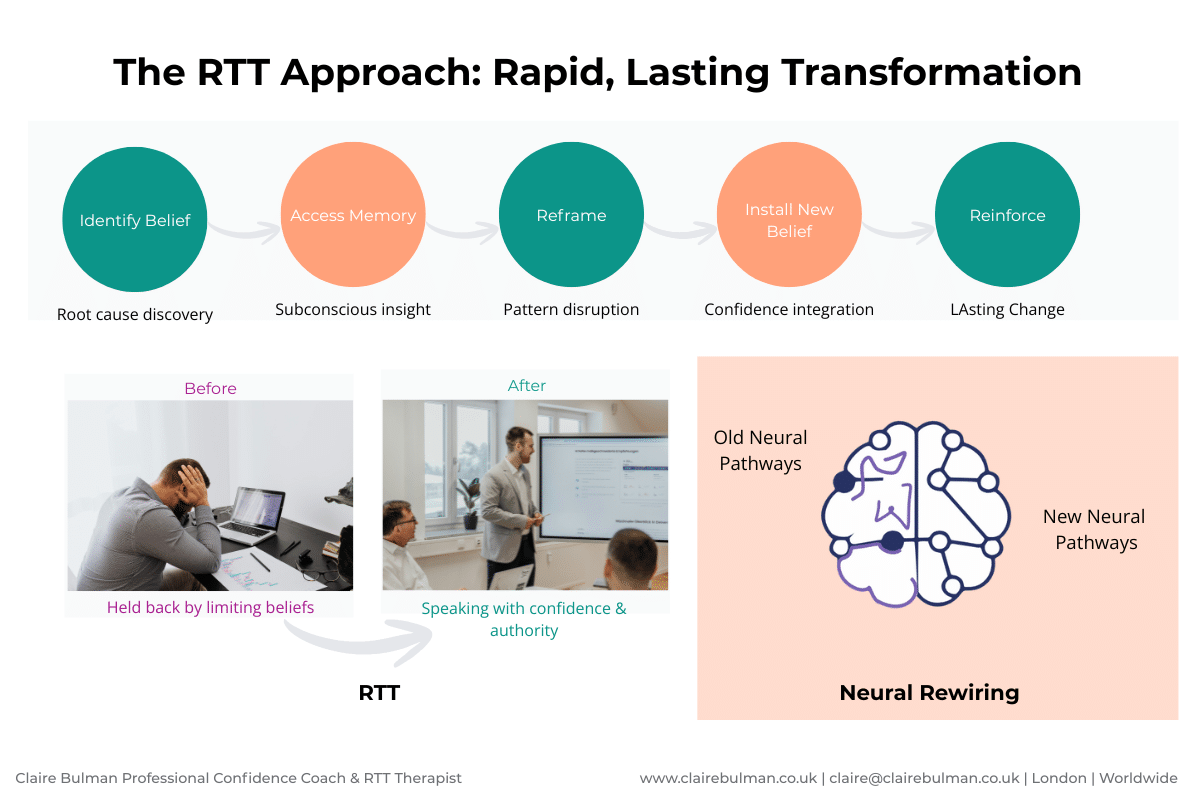
The VP’s Transformation
The Problem: Severe anxiety during board meetings. Sleepless nights. Fear of aggression.
The Session: The client accessed the memory at age 7. He recognised the father’s harsh reaction to his speaking up and his Mother’s silence. Then came the understanding that his child’s mind decided: Speaking up causes aggression. Better stay silent.
The Reframe: As an adult, he saw clearly that his father’s aggression wasn’t about him. It was about his father’s stress and need for control, which was a parenting failure. not a sign of the child’s inadequacy.
The Transformation: After the session, within days, he spoke at Board meetings with a calm he’d never felt before. It was noted, and his colleagues congratulated him on his contribution. It was like the issue had never existed. No more catastrophizing or sleepless nights. The inner resistance had disappeared, and he no longer had to force himself to be confident. He simply removed the block that made him think he couldn’t.
Why This Works for Professionals
Time-Efficient: You’re busy. You don’t have years for weekly therapy. RTT gets to the root cause in one to three sessions, usually in a single session lasting 90 to 120 minutes. (Raveendran & Kaliaperumal, 2021)
Evidence-Based: RTT combines hypnotherapy, NLP, CBT, and psychotherapy. It’s grounded in neuroscience and the idea that beliefs create neural pathways, which can be changed.
Results-Focused: RTT delivers real, measurable results. As a professional, you care about ROI. RTT gives you results you can see. You don’t just feel different—you act differently. Colleagues notice, and your performance improves. (Rapid Transformational Therapy: RTT®, 2021)
Natural, Not Forced: You no longer have to manage anxiety. The resistance is gone because the belief that caused it is gone.
What Changes
Before: You rehearse what you’ll say. Your heart races. Anxiety floods in. Your comment stays locked inside. You leave feeling frustrated.
After: A relevant topic comes up. You have thoughts and share them naturally. There is no inner debate or forcing yourself. You contribute because your perspective matters.
Every other approach works at the conscious level, which is just 5% of your brain. RTT works at the subconscious level, the 95% that actually drives your behaviour. (Bruna, 2025)
Traditional approaches try to override the program. RTT changes it.
Traditional approaches take years. RTT takes sessions. (Raveendran & Kaliaperumal, 2021, pp. 13-14)
Traditional approaches require ongoing effort. RTT creates permanent change. I
It is time to rewrite the program.
This New Year, Do Something Different
Here’s the uncomfortable truth: If you set the same goals this year as last year, and the year before, you already know how this ends.
By mid-February, you’ll drop the goal. By March, you’ll stop thinking about it. By next December, you’ll set the same resolution, convinced that this time you’ll have enough discipline to make it work.
Einstein’s definition of insanity fits here: doing the same thing over and over but expecting different results.
Your goals look the same because the beliefs underneath have not changed. You cannot think your way out of a subconscious problem because you don’t even know it is there.
So this year, you have a choice: repeat the pattern or break it.
What Becomes Possible When You Break the Pattern
See yourself walking into Monday’s strategy meeting and speaking up without forcing it, managing anxiety, or rehearsing in your head. You just have thoughts and share them, the way other confident people do.
Hear yourself in a performance review where your manager asks about your career goals. Instead of that familiar tightness in your chest when you think about asking for the promotion, you clearly articulate what you want and why you deserve it. No guilt, no second-guessing, just being certain about your own abilities and expressing that effortlessly.
Think about what it would be like to be recognised for your work, not because you forced yourself to be visible, but because it feels natural. The internal brake that held you back for years is gone.
This isn’t a fantasy. This is what happens when you remove the subconscious blocks that have shaped your behaviour since childhood.
This is what the VP experienced. This is what becomes possible when you address the actual problem.
The Investment That Changes Everything
Think about what you’ve already invested in your career.
Years of education. Professional certifications. Skills training. Networking events. Leadership courses. Self-help books. Maybe therapy or coaching. You may have invested tens of thousands in building your capabilities.
But if a belief you picked up at a young age keeps you from using your skills when it matters most, such as in meetings, negotiations, presentations, or promotion talks, you are not getting the return on your investment.
RTT is not just another expense. It removes the barrier between you and the potential you have already built.
It is finally paying off everything you have invested in yourself.
With just one to three RTT sessions, you can make progress that might otherwise take years of traditional therapy, months of coaching, or another decade of setting goals that don’t work because you’re using conscious tools for a subconscious problem.
Think about what it costs to spend another year staying quiet. What about missing out on a promotion you don’t apply for, or avoiding another salary negotiation? How much longer will your potential stay hidden because of beliefs you didn’t choose?
What to do next
The voice in your head, the one telling you to stay quiet.That you’re not ready, that speaking up is too risky. These thoughts have been holding back your career for too long.
This year, find out where that voice really came from. Then, replace it with your own.
I offer complimentary discovery consultations where we explore:
* The specific block that’s holding you back
* Where it likely originated
* Whether RTT is the right approach for your situation
* What transformation could look like for you?
There is no pressure and no obligation. It is just a conversation to see if this approach fits what you’d like to do.
January slots are limited, and for good reason. The New Year is when motivation is highest, and the difference between repeating the same pattern and making a real change is most obvious. This is the time to act.

I’m Claire, an RTT practitioner specialising in helping professionals break free from limiting beliefs. In our consultation, we’ll explore what’s specifically holding you back.
BOOK YOUR COMPLIMENTARY CONSULTATION
A Final Thought
You are not broke, and you do not lack willpower. You are capable of being the leader you want to be.
You are just running old programming.
Your goals can be realised. Currently, they don’t match the beliefs your subconscious formed before you were old enough to question them.
But here is the truth: You can rewrite those beliefs. You can replace someone else’s fear with your own real voice, and you can finally break free from patterns that have held you back for years.
That banking VP spent 30 years thinking his problem was anxiety, his colleagues, or his lack of confidence. But really, the problem was a decision his seven-year-old self made at the dinner table.
One session changed thirty years of behaviour.
What could change for you this year when you address the real problem?
Let us find out together.
BOOK YOUR COMPLIMENTARY CONSULTATION
Make this the year you finally break free.
References
Bargh, J. A. & Morsella, E. (2008). The Unconscious Mind. Perspectives on Psychological Science 3(1). https://doi.org/10.1111/j.1745-6916.2008.00064.x
Raveendran, S. & Kaliaperumal, C. (2021). Rapid Transformational Therapy (RTT): An Emerging Non-invasive Therapeutic Modality. Biology 7(2). https://doi.org/10.5530/bems.7.2.6
(2021). Rapid Transformational Therapy: RTT®. RTT Method. https://rtt.com/method/
Bruna, M. A. (2025). Resonance Complexity Theory and the Architecture of Consciousness: A Field-Theoretic Model of Resonant Interference and Emergent Awareness. arXiv:2505.20580. https://doi.org/10.48550/arXiv.2505.20580
FAQ’s
Q: What are limiting beliefs? A: Limiting beliefs are subconscious beliefs formed in childhood that restrict your behaviour as an adult, often causing workplace confidence issues like the inability to speak up in meetings.
Q: How does RTT differ from traditional therapy? A: RTT addresses root causes in 1-3 sessions by accessing subconscious memories, while traditional talk therapy may take years working at the conscious level.
Q: Can RTT help with workplace confidence? A: Yes, RTT is particularly effective for professionals struggling with speaking up at work, as it removes the subconscious blocks causing the anxiety rather than just managing symptoms.
Q: How long does RTT take? A: Most clients experience transformation in 1-3 sessions of 90-120 minutes each, compared to years of traditional weekly therapy.
Q: Can limiting beliefs really affect workplace confidence that much?
A: Yes. Limiting beliefs formed in childhood are the primary cause of workplace confidence issues in high-achieving professionals. These subconscious beliefs override conscious skills and create behaviours like staying silent in meetings or avoiding promotions, directly sabotaging workplace confidence despite qualifications.